
How to Automatically Sync Customer-Specific B2B Prices from Your ERP to Your Online Shop
Manual maintenance of B2B prices takes time and causes errors. Learn how to connect your ERP system directly with your online shop for automated customer terms.
Challenge: Individual pricing logic in B2B commerce
In B2B business, uniform selling prices are the exception. Every customer has individually negotiated terms, master agreements, tiered pricing, or special discount groups. This logic is deeply embedded in your ERP system and has been proven there for years.
When you operate a B2B online shop, your processes face a challenge. As soon as a business customer logs into the shop, they must see exactly the prices stored in their master agreement. If these terms are transferred manually from the ERP to the shop, delays and input errors occur. Incorrect prices in the shop lead to inquiries with sales or, in the worst case, faulty orders.
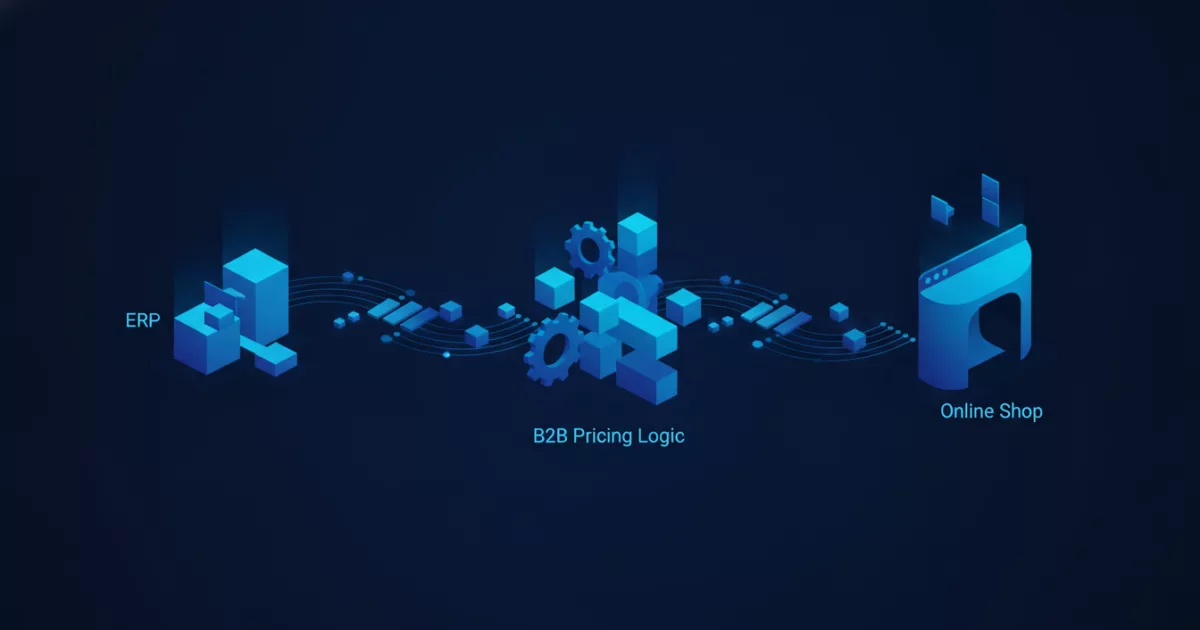
The key is not to view the online shop as an isolated island, but as a seamlessly integrated part of your overall process chain. Central maintenance takes place exclusively in one location: inside your ERP system. The shop retrieves the data from there automatically.
Typical pricing models for ERP shop synchronization
- Customer-specific net prices are directly assigned to the respective customer account based on stored master agreements.
- Quantity-dependent tiered prices in the shop adapt automatically to the entered order volume of the items.
- Percentage discounts on entire product categories are dynamically updated during adjustments in the ERP.
- Customer-specific currencies and country settings are taken into account based on the master data in the ERP.
How b2b price sync erp shop works technically
For an automatic b2b price sync erp shop, there are two proven architectural approaches: synchronous querying in real time or asynchronous synchronization via cached data. Which variant fits depends on your systems and data volume.
With synchronous real-time querying, the shop sends a direct request via interface to the ERP at the moment of login or when opening a product page. The ERP calculates the individual price for this specific customer and returns the value immediately. The advantage lies in absolute topicality. However, the ERP system must be highly available and respond extremely fast so as not to impact the shop's loading time.
With asynchronous synchronization, the ERP transfers modified price tables at regular intervals or event-based to a middleware or the shop. The shop accesses this pre-cached dataset. This guarantees fast loading times in the frontend, but requires clean logic for data reconciliation in the background.
Interfaces and data consistency in the background
For data exchange to run smoothly, interfaces must be precisely defined. A clear assignment of customer numbers, item numbers, and currency codes is essential. When new customers are created in the ERP or conditions are adjusted, the interface must reliably detect these changes.
A central aspect is error handling. If the connection between ERP and shop is interrupted, the shop must not display incorrect default prices. In such cases, defined fallback mechanisms take effect, or the price display is temporarily restricted in a controlled manner. Additionally, log files should log all transmissions so your IT team can quickly trace discrepancies if needed.
This background automation completely eliminates duplicate data entry. Your sales and back-office teams no longer need to manually compare price lists or import spreadsheets. This saves working time and prevents costly input errors.
Important note: For special contractual or tax regulations such as cross-border transactions, specific tax rates, or special customs duties, you should always consult appropriate specialists such as tax advisors.
Optimize automated processes with webfellows
webfellows is an agency from Würzburg with over 15 years of experience in e-commerce. Our focus is on AI-based process automation and web applications for medium-sized enterprises. We support you in establishing your shop as an efficient part of your digital process chain.
Our reference projects, such as the INOSYS datahub, the souvenir shop for the city of Würzburg, or Schönberg Energy, demonstrate that extensive automation works reliably in practice. At Schönberg Energy, a portal for brokering electricity and gas contracts, the business model runs 90 to 95 percent automated.
Would you like to explore how your B2B prices and interfaces between systems can be optimized? Contact us for a non-binding process check with webfellows.
This article was created with AI assistance.
Comments
No comments yet. Be the first to tell us how this works for you.

